Every container gardener—including my past self—has wondered how to check sunlight on a balcony or terrace and find the right spot for each potted plant. Once you understand your plants’ light requirements and the role of photosynthesis in healthy growth, the next big challenge begins: figuring out where each container should actually sit and how to keep meeting those light needs throughout the year.
This is where many beginner balcony and terrace gardeners struggle. Plants grow slowly, leaves start turning yellow, the potting soil stays soggy in one corner but dries out too quickly in another, flowering reduces, and plants look stressed even when you’re watering them properly. Most of the time, the problem isn’t the plant—it’s that we haven’t understood how sunlight behaves in our own growing space.
Some of you might think you need expensive gadgets to check sunlight. You don’t. All you really need is your phone, a few notes, and a little awareness of how sunlight shifts across your balcony or terrace during the day.
Some gardeners observe sunlight only by directions—east-facing, west-facing, south-facing, or north-facing. That isn’t entirely wrong, but sunlight intensity and patterns change throughout the year. That’s nature, and it’s completely normal. As a beginner, don’t judge your growing space based only on directions. They give you a starting point, but they don’t tell you how sunlight actually behaves on your balcony or terrace under Indian gardening conditions.
Reading sunlight is mostly about observation and note-taking. In the beginning, spend one full day watching how the light moves across your growing space. Then keep noticing how those patterns change with the seasons. Once you’ve collected a year’s worth of observations for your balcony or terrace, you’ll rarely misplace your container plants because you’ll already know which spots receive full sun, partial sun, or bright indirect light.
You don’t need expensive sunlight meters or complicated apps. You simply need to understand that sunlight isn’t rigid. It changes with the Earth’s movement, seasonal shifts, weather conditions, and even nearby buildings casting different shadows.
The good part is that once you understand your balcony or terrace, that knowledge stays with you. The sunlight may shift slightly from season to season, but your observations become one of the most valuable gardening tools you have. In the rest of this guide, I’ll show you exactly how to observe and map sunlight in your own space without using any special tools.
If you’re moving plants around every day for better light, this may change how you garden. Read: Should You Move Container Plants Daily for Sunlight?
What Are the Signs I'm Misjudging the Sunlight in My Balcony or Terrace?
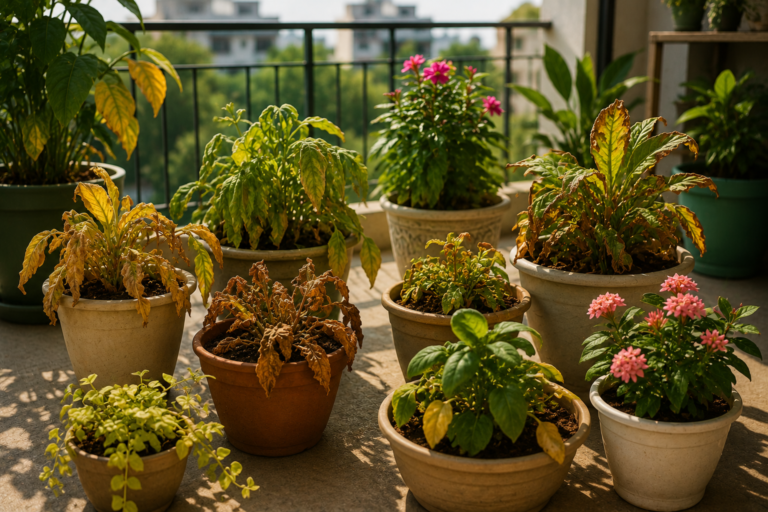
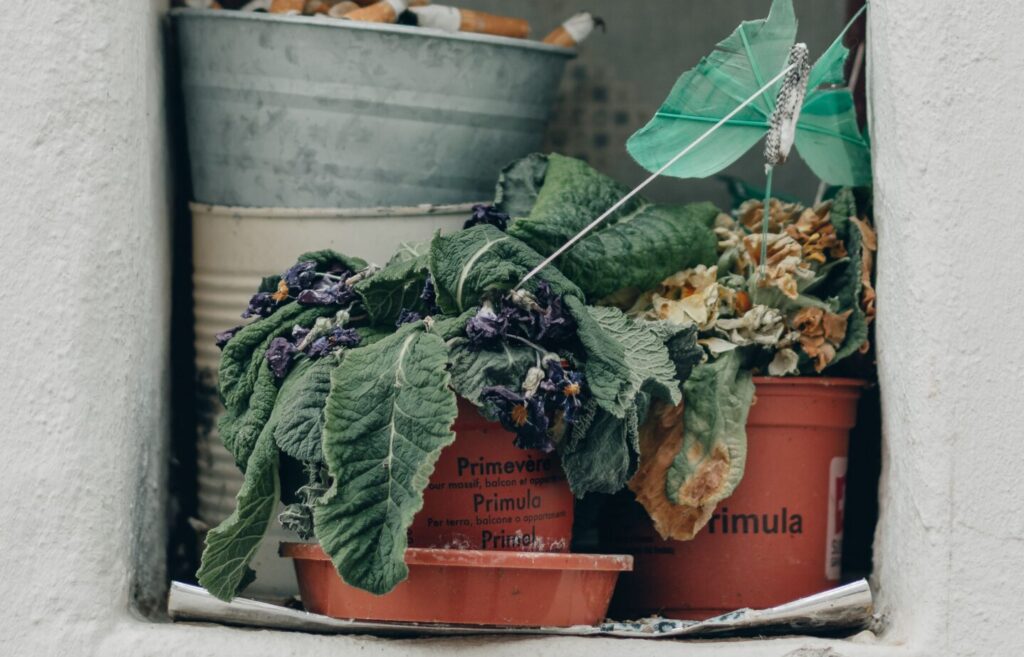
are actually caused by sunlight. When a potted plant starts wilting, growing slowly, or looking unhealthy, our minds immediately jump to watering, fertilizer deficiencies, pests, or poor soil. Sunlight is often the last thing we question, even though it’s one of the biggest reasons balcony and terrace plants struggle.
Many gardeners also carry simple myths about sunlight—“full sun is always best” or “this plant should only stay in shade.” But what we often miss is observing the plant itself and asking a better question: Is this plant’s light requirement actually matching the sunlight available in my balcony or terrace?
You may have noticed some of the signs below without knowing their real cause. In this section, you’ll learn how sunlight affects these common container gardening problems and when it’s actually the reason behind them.
Why do my plants look unhealthy even though I’m watering them regularly?
Balanced watering alone doesn’t keep a plant healthy. A plant also needs the right amount of sunlight, nutritious soil, fertilizers when needed, pruning, and proper pest and disease management. Healthy container gardening is about ticking all of these boxes together—not just one of them.
Let’s say you’ve given your potted plant healthy soil, regular fertilizers, routine care, and kept pests under control. Yet the plant still looks dull, weak, or refuses to grow properly. That’s when I start questioning whether it’s actually a sunlight mismatch.
Plants need sunlight to perform photosynthesis. Along with water and carbon dioxide, sunlight helps produce glucose, which becomes the plant’s food for growing new leaves, stronger roots, flowers, and fruits.
When sunlight becomes excessive, the potting soil loses moisture quickly because of heat, and the plant loses water through faster evaporation. This puts stress on photosynthesis. On the other hand, when there isn’t enough sunlight, photosynthesis slows down because the plant simply isn’t receiving enough energy.
In both situations, the result is similar—the plant cannot produce enough food for healthy growth. That’s why container plants often look weak or stop thriving even when you’re watering them correctly.
Why are my leaves turning yellow, brown, or getting scorched?
These signs may look similar, but they don’t always mean the same problem.
Yellow leaves are often caused by insufficient sunlight. With reduced photosynthesis, chlorophyll production also decreases, making leaves gradually lose their healthy green colour.
Brown leaves need a little closer observation. If the leaves become dry, crispy, and brown, excess sunlight is usually the reason. But if you notice brown spots with yellow halos or tiny dots while the soil stays constantly moist because of poor sunlight and limited airflow, you’re more likely dealing with fungal leaf spots instead of sun damage. Sometimes leaves even turn black because prolonged wet soil leads to rot.
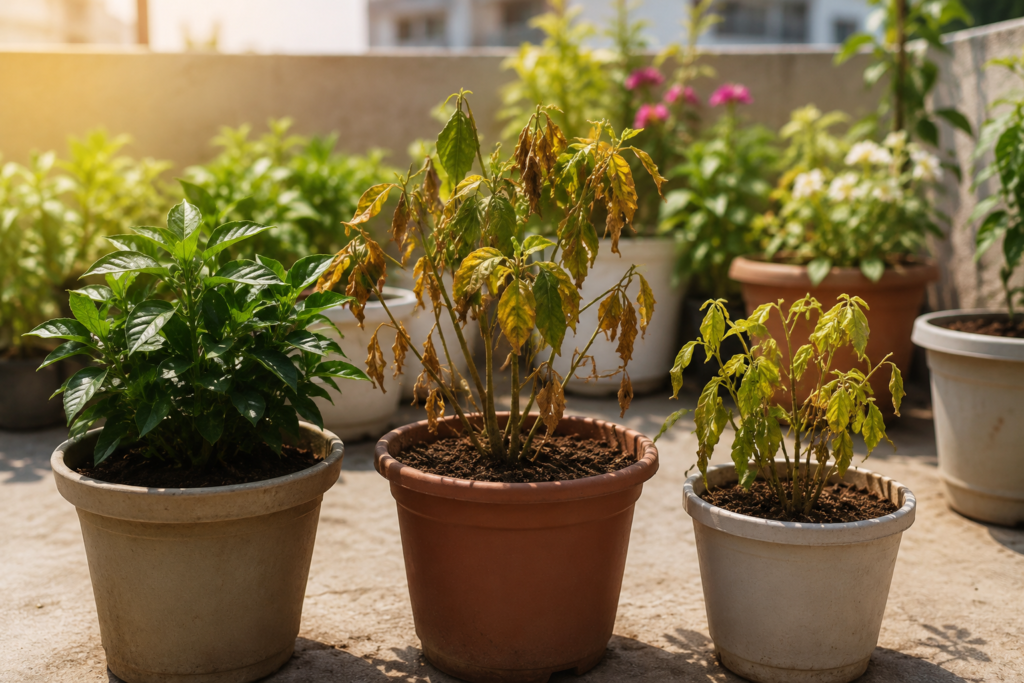
Scorched leaves are usually easier to identify. Crispy brown edges, curled leaves, and dry, burnt-looking foliage are clear signs that the plant is losing moisture faster than it can replace it. Under intense Indian summer sunlight, especially in containers, this happens much faster because both the foliage and potting soil heat up quickly.
Why are my flowering plants not blooming or growing properly?
If your flowering plants become leggy, stretch toward one side, or lean toward the sunlight, they’re usually asking for more light.
The reason goes back to photosynthesis. Sunlight helps plants produce glucose, which fuels new leaf growth, flowering, fruiting, and healthy foliage colour. When photosynthesis slows down because of insufficient sunlight, the plant simply has less food available.
Instead of investing energy in flowers or fresh growth, it starts using whatever food it has just to survive. That’s why flowering reduces, growth becomes slow, and the overall plant starts looking weak.
The opposite problem can also happen. Excessive heat causes faster evaporation from both the leaves and the potting soil. Water is essential for carrying nutrients and supporting many natural processes inside the plant. When moisture disappears too quickly, healthy growth slows down even if nutrients are present in the soil.
Why do some containers thrive while others struggle in the same balcony?
Most of the time, this comes down to incorrectly observing the sunlight in each spot and matching the wrong plant to the wrong location.
Sunlight tolerance isn’t just about whether a plant is labelled as “sun-loving.” Even full-sun plants can struggle under harsh Indian summer temperatures above 33°C because they lose water rapidly through both their leaves and the potting soil.
Meanwhile, the thriving plant beside it may simply have an advantage. It could be a mature plant with a stronger root system, succulent-like fleshy leaves that store more water, a potting mix that retains moisture longer, or it may simply be in its preferred sunlight conditions during its active growing season. Flowering plants, in particular, often need more sunlight than many foliage plants.
Even after you’ve placed a plant in what seems like the correct sunlight spot, keep observing it. If you notice early signs of scorching, don’t wait for severe damage. Monitor the sunlight intensity, use a shade net or a light cloth during harsh afternoon heat if necessary, and rotate containers occasionally so the plant receives more even sunlight.
The good news is that once you learn to read these signs instead of guessing, choosing the right spot for each container becomes much easier—and that’s exactly what we’ll cover next.
Your plants can struggle with low light even when they’re kept outdoors. Find out why: Why Your Container Plants Aren’t Getting Enough Light
Full sun doesn’t always mean healthy plants. Discover why your container plants may still be struggling: Why Are Your Container Plants Struggling Even in Full Sun?
Why Does Checking Sunlight Matter More for Container Plants Than I Realize?
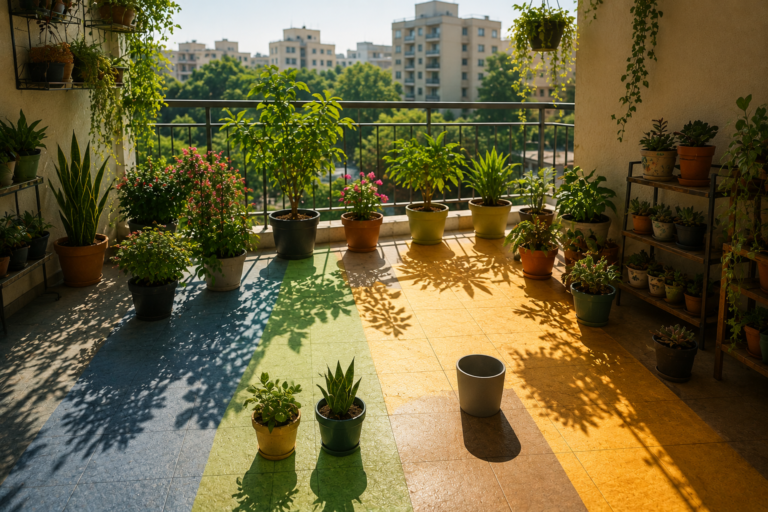
Container gardening doesn’t depend on just one thing. It’s about aligning many small factors that help a plant survive and thrive inside a pot. I like to think of it as creating a micro-climate and micro-environment for every container plant. Sunlight is one of the biggest parts of that micro-climate because it affects temperature, soil moisture, water loss, and ultimately plant growth. When the light is right, many other parts of plant care become much easier.
Why does sunlight behave differently in balconies and terrace gardens?
Balconies and terraces don’t receive sunlight the same way.
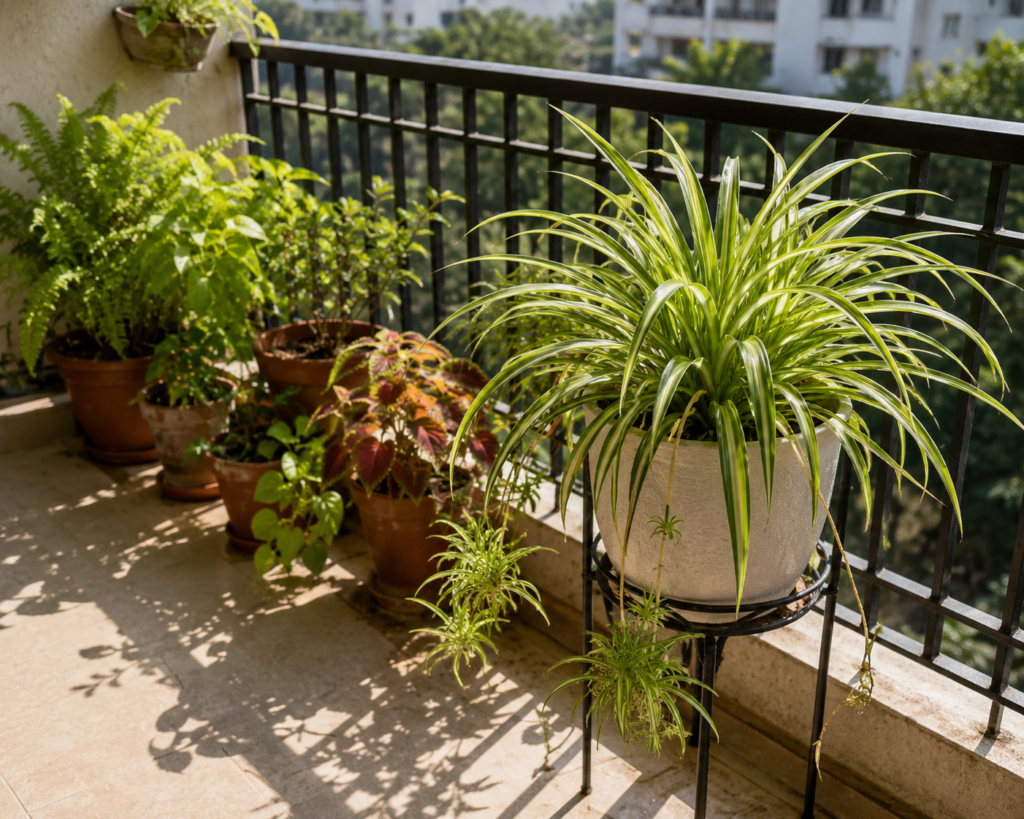
A balcony usually has much more limited light exposure than an open terrace. The amount of sunlight depends on the balcony’s facing direction, nearby buildings, walls, grills, trees, and even neighboring apartments. All of these create moving shadows that change how much direct sunlight actually reaches your potted plants.
An open terrace generally receives more light, even if a particular spot isn’t getting direct sun all day because bright indirect light is still available. But don’t assume every terrace is full of sun. Covered terraces, rooftop structures, water tanks, pergolas, or surrounding buildings can change sunlight patterns just as much as balconies do.
This is why I always recommend reading your growing space before buying plants. If your balcony receives only a few hours of sunlight throughout the year, many sun-loving plants will struggle just to survive. While grow lights are an option, they aren’t practical or affordable for every gardener. Understanding your natural sunlight first saves both money and plants.
Even if you can move containers around later, you still need to know where the sunlight actually reaches and for how long. That simple observation prevents many beginner container gardening mistakes.
Why are container plants more sensitive to incorrect sunlight than garden plants?
Potted plants depend entirely on the small environment we create for them. Unlike plants growing in the ground, they have limited root space, limited soil volume, and very little buffer against sudden changes in temperature and moisture.
That makes container plants much more sensitive when sunlight isn’t matching their needs. Too much sun heats the pot, the soil, nearby walls, and even the floor beneath it. Too little sun slows growth and affects the plant’s ability to produce food through photosynthesis.
Of course, ground-grown plants can also suffer from poor sunlight, but they usually have larger root systems and cooler soil that help reduce stress.
Good container gardening is often about making small adjustments. Rotate your pots so all sides receive light evenly. Shift plants when seasonal sunlight changes. Observe how quickly the soil dries in different locations. These simple habits become part of routine plant care.
In Indian balcony and terrace gardens, one of the biggest hidden problems is heat coming from the surroundings. Hot floors, sun-heated walls, railings, and nearby concrete surfaces raise the temperature around your pots. This changes the plant’s micro-environment, dries the potting soil faster, increases water loss, and puts extra stress on the roots.
Once you understand these hidden factors, it’s much easier to avoid them and create healthier growing conditions for your container plants.
Why can the same balcony have different sunlight zones?
One thing that surprised me most was realizing that the same balcony can have several different sunlight zones.
Unlike an open garden, balconies and terraces have walls, corners, ceilings, railings, hanging hooks, and nearby buildings that constantly change how sunlight falls throughout the day. On top of that, sunlight duration, angle, and intensity naturally change with the seasons because of the Earth’s movement.
Getting to know your own growing space is one of the best things you can do as a gardener.
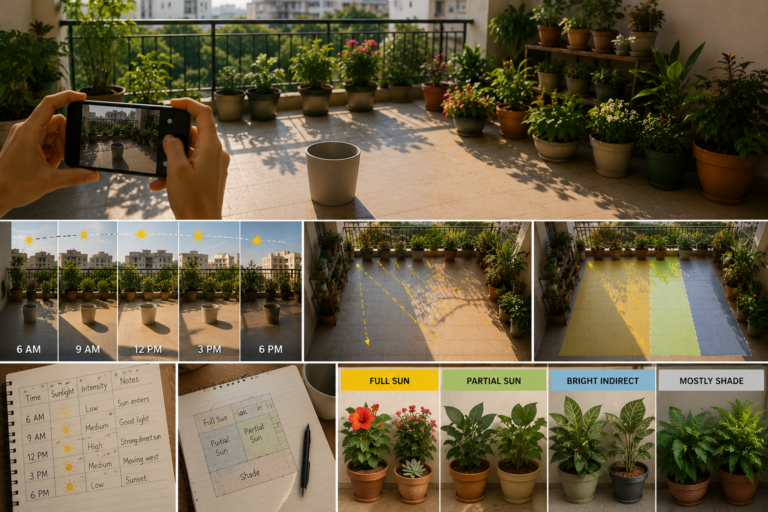
For your first observation, spend a day watching your balcony or terrace from around 6 AM to 6 PM. Take a photo of the same spot every hour. This gives you a simple record of when direct sunlight starts, when it ends, and how long each area stays bright.
To understand sunlight intensity without any tools, place an empty pot or any object in that spot and observe its shadow. A dark, sharp shadow usually means strong direct sunlight. As the shadow becomes softer and less defined, the sunlight intensity is also reducing.
Remember, these observations only represent the current season. When seasons change, repeat the same exercise because sunlight duration and patterns will shift. In most balconies, you’ll also discover naturally shaded areas near walls, corners, hanging baskets, and under shelves. Once you identify these sunlight zones, choosing the right place for each plant becomes much easier—and that’s exactly what we’ll build on in the next section.
If your plants are stretching, wilting, or growing slowly, incorrect sunlight may be the reason. Read: How Much Sunlight Do Container Plants Need?
How Can I Check Sunlight in My Balcony or Terrace Without Any Tools?
Step 1: Observe your balcony at different times of the day
The simplest way to understand your growing space is to observe it for one full day. From around 6 AM to 6 PM, take a photo of the same spots every hour. Place an empty pot, bucket, or any object in those spots before taking the pictures. Keep all your observations in your phone’s Notes app or a small notebook.
This one habit helps you understand several important sunlight factors at once. You’ll know how much overall light your balcony or terrace receives, how many hours each spot gets direct sunlight, and how sunlight moves from morning to afternoon and evening.
The object’s shadow also tells you about sunlight intensity. A dark, sharp shadow usually means strong direct sunlight. As the shadow becomes softer and less defined, the light is becoming indirect or low intensity. The duration tells you approximately how many hours of sunlight each spot receives, while the pattern shows where sunlight travels during the day. Together, these observations make it much easier to match plants with the right location.
Watching your space for multiple hours also prevents one of the biggest beginner mistakes—judging a spot based on a single observation. Sunlight is constantly moving, so one photo at 10 AM never tells the full story.
Step 2: Watch where the sunlight actually falls
Now start following the sunlight instead of just looking at your plants.
Notice where the sunlight first enters your balcony or terrace, how it moves across the floor, and when it disappears. This helps you estimate the sunlight duration for each spot and understand which areas receive strong direct sunlight and which stay bright without direct exposure.
While doing this, you’ll naturally discover full-shade areas too. If possible, avoid placing most plants there. Even many shade-loving or low-light plants still benefit from some natural daylight to stay healthy.
You’ll also find bright indirect light spots. These are excellent locations for many indoor foliage plants and houseplants that struggle under harsh direct sunlight.
Step 3: Repeat your observations for two or three days
Sunlight patterns don’t usually change every day. They change mainly with the seasons, roughly every three to four months.
Repeating the observation for two or three days simply helps confirm what you noticed on the first day. It also helps you identify temporary interruptions like cloudy weather, nearby construction, or shadows from neighboring buildings that may affect your readings.
A clear sunny day often gives the most accurate picture, but observing your space for a few days gives you much more confidence before arranging your container plants.
Step 4: Divide your growing space into sunlight zones
Once you’ve collected your observations, divide your balcony or terrace into simple sunlight zones.
- Full Sun Zone
- Partial Sun Zone
- Bright Indirect Light Zone
- Mostly Shade Zone
This makes future plant placement much easier because you’re no longer guessing where each plant should go.
(Refer to the sunlight zone table below.)
Step 5: Match plants to the correct sunlight zone
If you’re a beginner or planning to buy new plants, this is where all your observations become useful.
Once you understand the sunlight available in your balcony or terrace, compare it with the light requirements of the plants on your wishlist before bringing them home. This simple habit prevents many common container gardening problems caused by placing plants in the wrong location.
It also helps you decide whether a particular plant is suitable for your space, whether you need to move existing containers during different seasons, or whether a grow light is worth considering for areas with very limited natural sunlight.
The more accurately you match your plants to your sunlight zones, the fewer problems you’ll face with slow growth, yellow leaves, poor flowering, and stressed container plants.
🌿 Guessing sunlight leads to struggling plants. There’s a simple way to observe it accurately. Click to learn the method
Sunlight Zone | Direct Sunlight | How to Identify It | Sunlight Intensity |
🌑 Zone 1 – Shade | No direct sunlight | No direct sunlight reaches the spot. You can’t see a clear shadow. Area stays cool all day. | Very Low |
🌤 Zone 2 – Bright Indirect | No direct sunlight | Bright enough to read a book. Very faint shadow. No sunlight falls directly on the leaves. | Low |
🌅 Zone 3 – Partial Sun | 2–4 hours | Receives 2–4 hours of direct sun, usually in the early morning or late afternoon. Shadow is visible but soft. | Low to Moderate |
☀️ Zone 4 – Morning Sun | 4–6 hours | Receives direct sun from sunrise until around 10–11 AM. Sunlight feels strong but comfortable. Leaves stay relatively cool. | Moderate |
🔆 Zone 5 – Full Sun | 6–8 hours | Receives direct sun for most of the day. Shadows are sharp and dark. Pots warm up noticeably. | Moderate to High |
🔥 Zone 6 – Harsh Sun | 6+ hours (includes 11 AM–3 PM) | Exposed to intense midday sun. Shadows are very dark. Pots become hot, leaf temperature rises quickly, and plants have a high risk of sun scorch. | Very High |
What Should I Do After I Know How Much Sunlight My Balcony or Terrace Gets?
The biggest goal of this guide isn’t just learning how to check sunlight—it’s learning to stop guessing. Instead of assuming how much sunlight your balcony or terrace receives, build your own record using simple observations and notes. You don’t need any tools, only consistency.
One thing I’ve learned over the years is that observing your garden is one of the most valuable gardening habits you can develop. Don’t just observe your plants—observe your growing space too. If something seems different, make a quick note. Over time, those small observations become your personal gardening knowledge, and no blog, video, or gardening tip can replace that experience.
Gardening advice is meant to guide you, but your own garden tells the real story. Every balcony and terrace has different sunlight patterns, temperatures, airflow, nearby buildings, and growing conditions. Having a record of your garden helps you apply gardening tips more confidently and avoid advice that simply doesn’t suit your space.
The most important thing to remember is that sunlight isn’t rigid. It changes with the seasons, the Earth’s movement, weather conditions, and even the angle of the sun. Sunlight duration, intensity, and patterns will all shift throughout the year. That’s why it’s worth repeating this simple sunlight observation whenever the seasons change instead of relying on guesswork.
Plants depend on sunlight to perform photosynthesis, which produces the energy they need for healthy leaves, roots, flowering, and fruiting. Providing the right amount of sunlight is one of the foundations of successful gardening, and in container gardening, understanding your light conditions gives you a real advantage because potted plants are much less forgiving than plants growing in the ground.
Once you’ve observed your balcony or terrace through an entire year, you’ve essentially created a personal sunlight map of your garden. From then on, choosing the right place for new plants becomes much easier because you already understand where the full sun, partial sun, bright indirect light, and shade zones appear in each season.
And finally, learning to read the sunlight on your own balcony or terrace is one of the best gardening skills you’ll ever develop. It’s a simple habit that saves plants, reduces trial and error, and helps you grow a healthier, more thriving container garden with confidence.