Which pot material is best for plants? This is the question every new gardener asks when buying pots for their container plants. Pot material is one of the factors that directly affects root health, watering, and ultimately the plant’s survival.
If you search for the answer, you’ll quickly be overwhelmed by the flood of information about pot materials and the different suggestions from dozens of gardeners and influencers.
In the Indian gardening market, only a few pot materials are dominant and widely used for container gardening. Plastic pots, clay pots, ceramic pots, and cement pots are the most common choices. Even though we also have grow bags, metal pots, and coco coir pots, these four are still the most widely available and used by balcony and terrace gardeners.
Many beginner gardeners assume that all pot materials are the same and work in the same way. No, they don’t. That’s one of the biggest misunderstandings about choosing pots for container plants.
Every pot material has its own pros and cons. Each one behaves differently when it comes to moisture retention, drainage, aeration, and temperature handling.
Choosing the wrong pot material can lead to moisture imbalance, drainage problems, poor airflow around the roots, and excess heat buildup inside the pot.
Those are the plant-related problems. On the other hand, maintenance, mobility, durability, and the overall quality of the pot are equally important when choosing the right pot material.
Your pot material should be chosen based on your microclimate conditions—not just your local weather, but the specific growing conditions on your balcony or terrace.
Along with that, you should also consider your local climate, available gardening space, watering habits, sunlight exposure, rainfall, heavy winds, and how often you’ll need to move the pot.
In this blog, I’ll walk you through how different pot materials behave and how they differ in moisture retention, temperature handling, maintenance, mobility, durability, and cost.
By the end of this blog, you’ll know exactly how to choose the right pot material for your plants based on your growing conditions.
How Can You Tell Which Pot Material Will Actually Suit Your Container Plants?
Pot material choices have to be made based on several factors—your garden, your microclimate, your usage, and the dominant local weather.
Along with knowing your garden needs, you can match the pot material behaviour to them. This kind of pot material selection helps avoid wasting money and time on pots that don’t match your garden and plant needs.
What Growing Conditions Should You Consider Before Choosing a Pot Material?
Microclimate is a key factor in pot material selection. This microclimate is not the season or local weather. Microclimate is how much sunlight, temperature, humidity, and airflow are around your plants.
These microclimate factors affect soil-drying time. Also, microclimate is not entirely affected by the season or weather; it’s about the structure of your garden space. Knowing your microclimate helps you find the right pot material.
Sun exposure—we all have unique garden spaces, and the plant’s microenvironment inside the soil will be affected by sun exposure and the heat created by the pot material. So, if you’re going to keep the pots in sun-exposed spots, you need a material that can handle the exposure and doesn’t pass extreme heat to the soil.
Rain exposure is a seasonal thing, but it needs to be a concern. Some of you might live in high-humidity areas or get frequent or heavy rainfall. This means the material needs to support good drainage, faster drying, and resistance to algae.
Wind exposure is a less-talked-about topic in Indian container gardening, but I was affected by this the most in my terrace container gardening. Terraces and balconies get more wind exposure than ground-level gardens. The higher your balcony or terrace is, the more wind exposure you may get.
Choosing pots that are sturdy and have enough weight can help handle strong winds and avoid toppling. If plants fall or topple frequently because of lightweight pot materials, the roots can get disturbed and stressed more.
Space availability is a key concern before buying pots because if you have less space and are going to utilize vertical space more, then the pot material choice should be based on that. The more weight you hang, the more strain it can put on hooks or railings.
Also, some pot materials are naturally bulky and occupy more space. If the goal is small-space gardening, then the pot material choices have to be made based on that.
Seasonal changes—before picking a pot material, knowing how the material behaves across different seasons helps avoid damage caused by seasonal changes.
How Do Your Watering Habits and Plant Needs Affect Pot Material Choice?
Watering habits take priority because the basic need of a plant is water to stay alive. If you’re someone with a busy lifestyle and choose a pot material that dries faster, your plants may end up under watering stress.
Also, picking a pot material that stays wet longer can backfire for some plants, especially succulents and houseplants that hate their soil staying wet for longer periods. So, the pot material helps maintain a moisture balance in the soil environment.
Pot material should also be chosen based on the plant’s moisture preference. It’s totally dependent on their root type and moisture tolerance. Remember, smaller saplings—even if they are drought-tolerant—can’t hold or absorb much water when they’re still in the seedling or sapling stage.
The pot material choice needs several areas of concern: the plant’s growth stage, plant type, root type, and your microclimate, which decides the soil-drying time.
The last factor I want to add from my personal experience is that if you have to move your pots frequently and you have bigger plants, choose a pot material that can be easily moved. It’s my lesson as a solo gardener—moving overweight pots frequently can strain your back and hands.
Before asking which material is best, first understand your plants and garden space, and match their needs with the pot material behaviour.
🌱 Healthy growth starts with the container itself — not the care routine. Click to uncover the overlooked truths
Why Do Plastic, Clay, Ceramic, and Cement Pots Behave So Differently in Container Gardening?
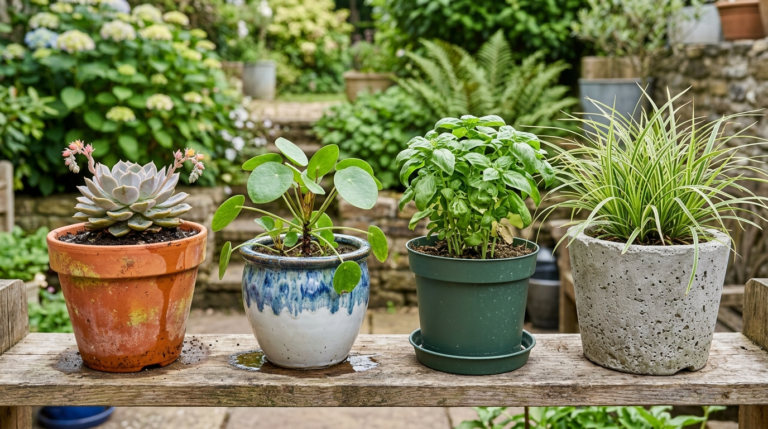
These pots are different, with different behaviours, because they are made from different materials. Every pot material reacts differently in Indian container gardening, especially on terraces and balconies. This difference can affect how quickly potting soil dries, how much heat reaches the roots, how often you need to water, and how easily the pot can be moved.
Knowing these differences helps you better understand pot materials rather than assuming that every pot will behave the same way.
How Do Plastic, Clay, Ceramic, and Cement Pots Differ in Moisture and Temperature?
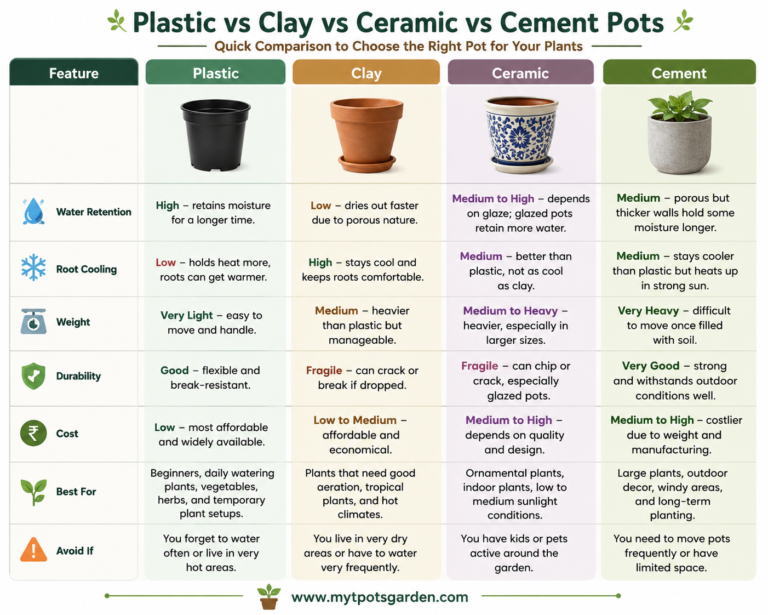
These materials have different moisture retention and temperature-handling behaviours. Plastic pots are non-porous, so they are generally more moisture-retentive unless the microclimate is airy and has better access to sunlight.
Clay pots are highly porous and better for aeration, allowing more airflow around the potting mix. These pots usually dry faster, except during winter and monsoon when the humidity in the air is high.
Ceramic pots can behave more like clay pots if they are unglazed. If they are glazed or polished with a coating, they become less porous and behave more like a non-porous pot. Cement pots can have some porosity, depending on how they are made, with pores that allow some airflow and moisture movement through the material.
When it comes to temperature, plastic pots react to both cold and heat depending on the thickness of the plastic. Thicker plastic absorbs heat more slowly. Ceramic pots also absorb and release heat or cold more slowly.
Clay pots absorb temperature changes faster, while cement pots can stay hot for longer once they absorb heat. Preferably, avoid placing any pot directly on the floor to reduce this heat absorption.
The reason moisture retention matters is that some plant roots are sensitive to wet soil, while others can tolerate more moisture. Knowing your plant’s root type and moisture tolerance is important when choosing the right pot material.
Then there is temperature, which affects the microenvironment inside the potting soil. It can influence moisture, microbial activity, and heat stress around the roots.
In Indian terrace and balcony gardening, the weather can be a bit high and dramatic. Summers can be hot and heat-reflecting, while winter and monsoon can bring higher humidity. Everything can feel a bit extreme, with sudden changes in weather.
Knowing your dominant weather and microclimate helps you find pot materials that can better tolerate those conditions.
How Do Pot Material, Weight, and Porosity Affect Everyday Container Gardening?
Every one of these pot materials has its own weight, and that decides mobility. Usually, plastic pots are lightweight, ceramic pots are medium-weight, clay pots are heavier than ceramic, and cement pots are usually the heaviest and most difficult to move.
Apart from plastic, the other three materials can have some level of porosity. Clay usually provides better airflow when it is unglazed, while unglazed ceramic can also allow some airflow. Cement pots can provide some aeration, but generally less than porous clay.
When it comes to outdoor exposure and durability, clay and cement pots can handle outdoor conditions well, but they also come with their own issues, such as heating up quickly and staying wet for longer during the monsoon.
When you’re gardening on a terrace or balcony several floors above ground level, unless you have someone to help you carry cement and clay pots up and down, the weight can strain your back and invite body aches. Also, if you have to move pots frequently to adjust their sunlight exposure, heavy pots can make the work much harder.
If you have strong wind exposure, lightweight plastic pots can be easier to topple, while ceramic pots can be easier to break if they fall.
There is no universal best or worst pot material. Your garden needs, microclimate, plants, watering habits, and available space decide which pot material is suitable for you. Understanding this behaviour makes it much easier to choose the right pot instead of simply choosing the pot that looks better.
🌱 Crowding, airflow, and root room matter more than pot count. Click to learn the real spacing rules
How Do You Choose the Best Pot Material for Your Container Plants?
With the above sections, you already know better about how different pot materials behave, their characteristics, and how they react to temperature and moisture.
With that, you already know there’s no single best or worst universally approved pot material. It’s about whether the pot material is going to function well for your garden needs and your convenience.
Before choosing any pot material, whether you’re a new gardener or a seasoned gardener, ask yourself a few questions. If the pot material answers those questions, you can consider buying it.
Ask: does the potting mix dry faster or stay wet in your chosen pot material? This gives you a picture of how that pot material reacts to moisture, and you can match that with your plant roots’ tolerance of moisture.
Ask: where are you going to place this pot—indoors or outdoors, near wind exposure or rain exposure? Is the pot material able to handle that exposure without affecting the plant or breaking itself?
Ask: is this pot going to sit on the floor, railing, windowsill, shelf, hanging space, or any other vertical space? This question gives you a picture of the pot material’s weight, durability, and how fragile it is.
Most importantly, ask yourself: can you move the pot freely even after filling it with soil? This can become an issue if you don’t pay attention to it before buying.
In my perspective, with 8 years of container gardening in Indian terrace conditions, I’ve used all four of these pot materials. I still have all of them in my garden. But the dominant pot material I use, with some tweaks, is plastic pots because they are lightweight and suit my situation as a solo gardener.
Use plastic pots if you are a solo gardener and need to move pots every few months for sunlight or seasonal changes. But make sure they have better drainage and airflow, and avoid placing them directly on the floor.
Use clay pots if you frequently overwater, have poor airflow around your plants, or keep losing plants to root rot, fungal issues, or soil staying wet for longer. Clay pots are breathable and hold moisture only for a shorter time, but avoid placing them directly on the floor.
Use ceramic pots, preferably unglazed, if you want a breathable material along with aesthetics. Ceramic pots are also suitable for indoor plants and plants that don’t need frequent movement. The risk of breaking is higher, and they are a bit more expensive than other pots.
Use cement pots if you don’t need to move them frequently and they are going to be used outdoors at ground level. These pots are sturdy and durable for outdoor use.
You may see pots that look perfect in nursery shops or online listings, but that doesn’t justify how useful they will be in your garden space.
Choose any pot material that fulfils the function of helping your plants thrive, gives you easy access to move them when needed, and fits your budget.
Before blaming your soil or watering routine, check whether the pot itself is causing the trouble: Why Some Pots Fail in Container Gardening
What Should You Do Next After Choosing the Right Pot Material?
Choosing the right pot material is not about finding one perfect pot for every plant. It’s about choosing a material that works with your plant, garden conditions, watering habits, space, and the way you actually garden.
Once you start using the pot, observe how your plants respond. If the soil dries too quickly, stays wet for too long, or the pot becomes difficult to manage, you’ll know that something needs to be adjusted.
But pot material is only one part of successful container gardening. Your potting mix, watering habits, and sunlight also work together to keep your plants healthy.
So, after choosing your pot, continue learning about these three areas in my other container gardening guides. They can help you understand what is happening inside your pots and make better decisions for your balcony or terrace garden.
You don’t need the perfect pot—you need the pot that works with the way you garden.
FAQ
Which pot material is best for Indian summers?
There’s no one globally best pot material. It entirely depends on your garden microclimate, plant needs, and your own gardening needs.
Are clay pots always better than plastic pots?
Not exactly. Clay pots are porous, while plastic pots are non-porous. The better material is the one that fulfils your garden and plant needs, not the one that is labelled as the best.
Do ceramic pots need drainage holes?
Yes. Even if the ceramic pot is porous, some ceramic pots are glazed, which reduces their porosity. Every pot needs proper drainage holes to avoid excess water staying in the soil and creating overwatering issues.
Can cement pots damage plant roots?
Not exactly. It’s more about how you handle and care for the plant. Any pot material can create problems if it is exposed to prolonged heat or unsuitable conditions that affect the microenvironment around the roots.
Which pot material lasts the longest outdoors?
Usually, sturdy and good-quality clay and cement pots are suitable for outdoor use. Ceramic pots are more fragile, while plastic pots can wear out with prolonged sun exposure.
Should beginners buy plastic or clay pots first?
Choose based on your budget, plant type, and garden needs rather than following random pot material suggestions or choosing based only on aesthetics.